
Short answer: Before buying a Type 2 portable EV charger with a UK plug, verify each part of the connection separately. The Accessoryup page documents a locked Type 2 configuration for the car end, a UK plug for the supply end, a 3.5 kW charging rating and a 5.5 m cable. It does not state a vehicle compatibility list, rated current, socket standard, protection functions, ingress rating or compliance certificate. Use the vehicle handbook to confirm Type 2, obtain the exact electrical requirements for the cable and measure the parking position. Do not treat a matching connector shape as a complete safety or performance specification.
Read the product name as four checks
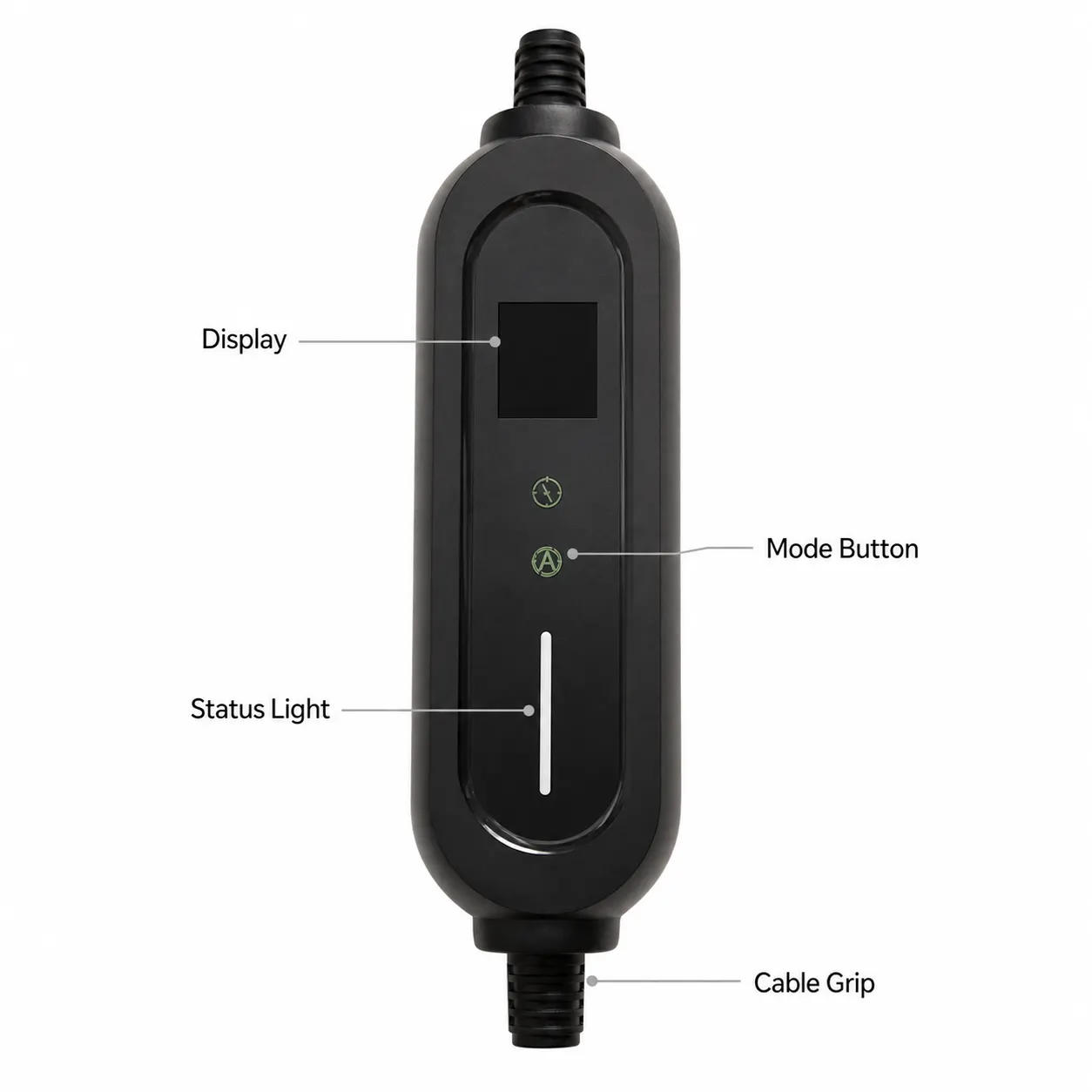
The current offer combines four facts: a T0 model reference, a locked Type 2 configuration, a UK plug, and a 3.5 kW rating on a 5.5 m cable. Each fact answers a different buying question. None supplies a list of compatible vehicles or confirms that every UK socket is intended for the load.
The product metadata also mentions a B-type variant label and ABS+PC housing. Those identifiers may help match the exact listing, but they do not prove electrical protection, outdoor durability or compliance with a named charging standard.
| Listing term | What it tells you | What it does not tell you |
|---|---|---|
| Type 2 | Vehicle-side connector configuration | Compatible makes and model years |
| UK plug | Supply-side plug format | Required socket and circuit condition |
| 3.5 kW | Published charging rating | Rated current or charging duration |
| 5.5 m | Published cable length | Connector and control-unit dimensions |
Check compatibility without guessing a model list
Confirm the inlet shown in the vehicle handbook and inspect the actual port. Do not rely on a broad statement that a brand commonly uses Type 2, because connector provision can vary by vehicle, market and charging method. Manufacturer does not specify a model or model-year list for this product.
If an adapter would be needed, pause the purchase. The page does not document adapter support, and an unlisted adapter changes both the mechanical and electrical connection. Ask for model-specific written guidance rather than copying compatibility from a similar cable.
- Identify the vehicle's AC charging inlet from its handbook.
- Match that inlet to the documented Type 2 end without an assumed adapter.
- Confirm the required UK socket, circuit and operating instructions for the exact cable.
- Measure the route and keep the order open until every connection point is documented.
Treat 3.5 kW as a rating, not a timetable
The listing's 3.5 kW figure is relevant when comparing equipment, but it is not enough to predict how long a particular battery will take to charge. Battery size, starting state of charge, onboard charger behaviour, vehicle settings and supply conditions all affect the result.
Manufacturer does not specify rated current, voltage range, efficiency, charging curve, automatic derating or time-to-charge examples. Keep journey planning separate from the purchase claim and use the vehicle's own information for realistic charging expectations.
Limits and checks before buying
Electrical Safety First says a dedicated EV chargepoint is the safest home arrangement and cautions that standard socket-outlets may not be designed for prolonged EV charging loads. GOV.UK technical guidance also shows that Type 2 is part of a wider standards and installation context; it does not confirm this listing complies with those standards.
Manufacturer does not specify the plug standard, required circuit, RCD or earth-monitoring functions, over-temperature protection, IP rating, operating temperatures, certification or inspection records. Ask for the manual and conformity information, and use competent electrical advice where the supply arrangement is uncertain.
Related guides and product details
Proceed only when the Type 2 inlet, UK supply, 5.5 m route and missing protection documents all match the exact vehicle and property. Read 3 Pin Type 2 EV Charging Cable: Check Both Ends for related guidance. Read Portable EV Charger for Visiting Family: UK Checks for related guidance. Review the documented specification on the Type 2 3.5 kW 5.5 m Portable EV Charging Cable with UK Plug product page before ordering.
Sources and safety context
- Supports the T0 and B-type identifiers, Type 2 and UK plug configuration, 3.5 kW rating, 5.5 m length and ABS+PC housing. Current Accessoryup portable EV charging cable product page.
- Supports checking the suitability of home socket arrangements and the preference for dedicated EV charging equipment. Electrical Safety Advice for Electric Vehicles.
- Supports the official Type 2 and installation-standards context while not asserting that this portable product meets the specification. Residential chargepoints: minimum technical specification.