
Short answer: A portable EV charger for visiting family is useful only when the guest's car, the host property's electrical supply and the parking route are all known in advance. The Accessoryup listing has a Type 2 vehicle connection, UK plug, 3.5 kW rating and 5.5 m cable. Manufacturer does not specify compatible models, socket requirements, rated current, weather protection or built-in electrical protections. Ask the visitor to confirm the car's inlet and charging instructions, measure the route from socket to charge port, and do not use a domestic extension lead to make up missing distance.
Collect the guest vehicle details first
Ask the visitor for the make, model, model year, charge-port position and the inlet shown in the handbook. The product page names Type 2 but does not list compatible vehicles. Manufacturer does not specify whether any adapters are supported, so plan for a direct match rather than an improvised connection.
Also ask how much charging is actually needed. A short local visit, an overnight stay and a next-morning motorway journey create different expectations. The listing gives a 3.5 kW rating but no charging-time claim, so the guest should keep another suitable charging option available if departure depends on a particular state of charge.
| Visitor check | Why it matters | Evidence to use |
|---|---|---|
| Vehicle inlet | Must match the Type 2 connection | Vehicle handbook or manufacturer |
| Charge-port position | Changes the required cable route | Vehicle inspection |
| Host supply | Must be suitable for EV charging | Socket markings and competent electrical advice |
| Required energy | Determines whether the visit window is realistic | Vehicle display and an alternative charging plan |
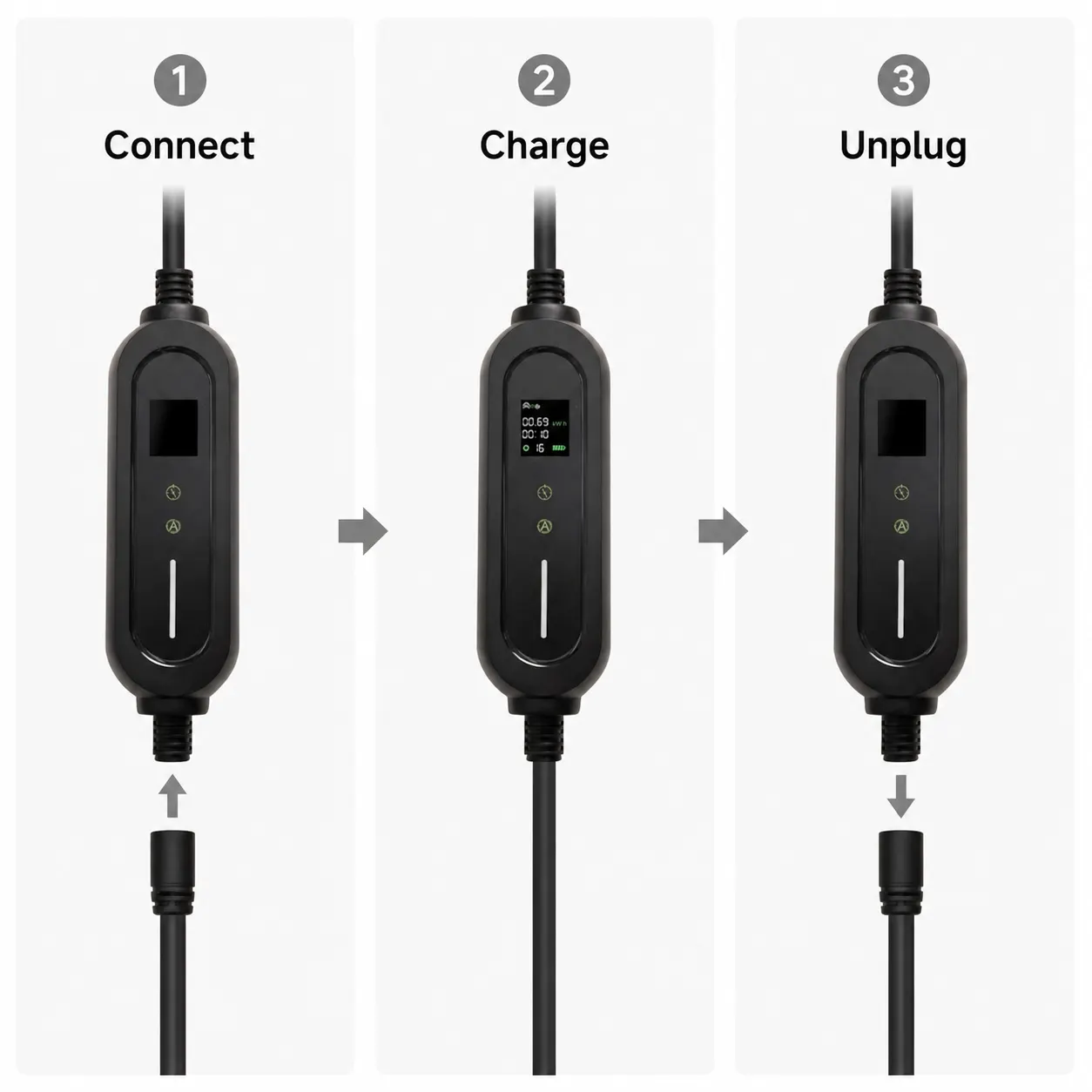
Measure the host parking arrangement
Measure from the intended socket to the parked vehicle's charge port along a safe, practical line. The documented cable length is 5.5 m. Leave room for connector alignment and avoid a route through doors, across steps or over a place where people need to walk.
If the car parks on the street, a private cable should not simply be laid across a public pavement. Local rules and authorised cable-channel arrangements vary. The product page does not state that the cable is approved for crossing a highway, and manufacturer does not specify a protective pavement system.
Prepare the supply without extension leads
Electrical Safety First advises against standard sockets for routine EV charging and says domestic extension leads should not be used for the task. A longer reach problem should therefore be solved by changing the approved parking or charging arrangement, not by joining leads or passing a plug through an unsafe route.
Before the visit, check the socket condition, circuit advice, cable markings and instructions for the exact unit. Stop the plan if the plug, socket or cable is damaged, becomes unusually hot or lacks the documentation needed for the property.
- Confirm the guest vehicle has the required Type 2 inlet.
- Measure a clear route that fits within the listed 5.5 m length.
- Verify the host supply and socket arrangement with appropriate electrical guidance.
- Agree an alternative public or dedicated chargepoint if any compatibility or safety detail remains unresolved.
Limits and checks before the visit
The Accessoryup product may be relevant to a Type 2 vehicle parked within reach of a suitable UK supply. It does not guarantee enough charging for a planned journey, and it is not evidence that an unfamiliar socket, adapter or outdoor route is acceptable.
Manufacturer does not specify vehicle models, rated current, plug standard, IP rating, cable-box dimensions, RCD functions, earth monitoring, thermal protection or certification. Resolve those points before purchase or use, especially when the host has not previously charged an EV at the property.
Related guides and product details
For a family visit, settle the car inlet, host supply and 5.5 m route before arrival, with a separate charging option ready if any detail stays unknown. Read Type 2 Portable EV Charger with UK Plug: Buyer Check for related guidance. Read 3 Pin Type 2 EV Charging Cable: Check Both Ends for related guidance. Review the documented specification on the Type 2 3.5 kW 5.5 m Portable EV Charging Cable with UK Plug product page before ordering.
Sources and safety context
- Supports the Type 2 connection, UK plug, 3.5 kW rating, 5.5 m cable and the limits of the published specification. Current Accessoryup portable EV charging cable product page.
- Supports avoiding domestic extension leads and checking that the home charging arrangement is suitable. Electrical Safety Advice for Electric Vehicles.
- Supports keeping charging cables from obstructing public routes and using authorised arrangements for pavement crossings. Charging at home.